The Tiger Leaping Gorge Cheat Sheet: I Did the Hard Work So You Don't Have To
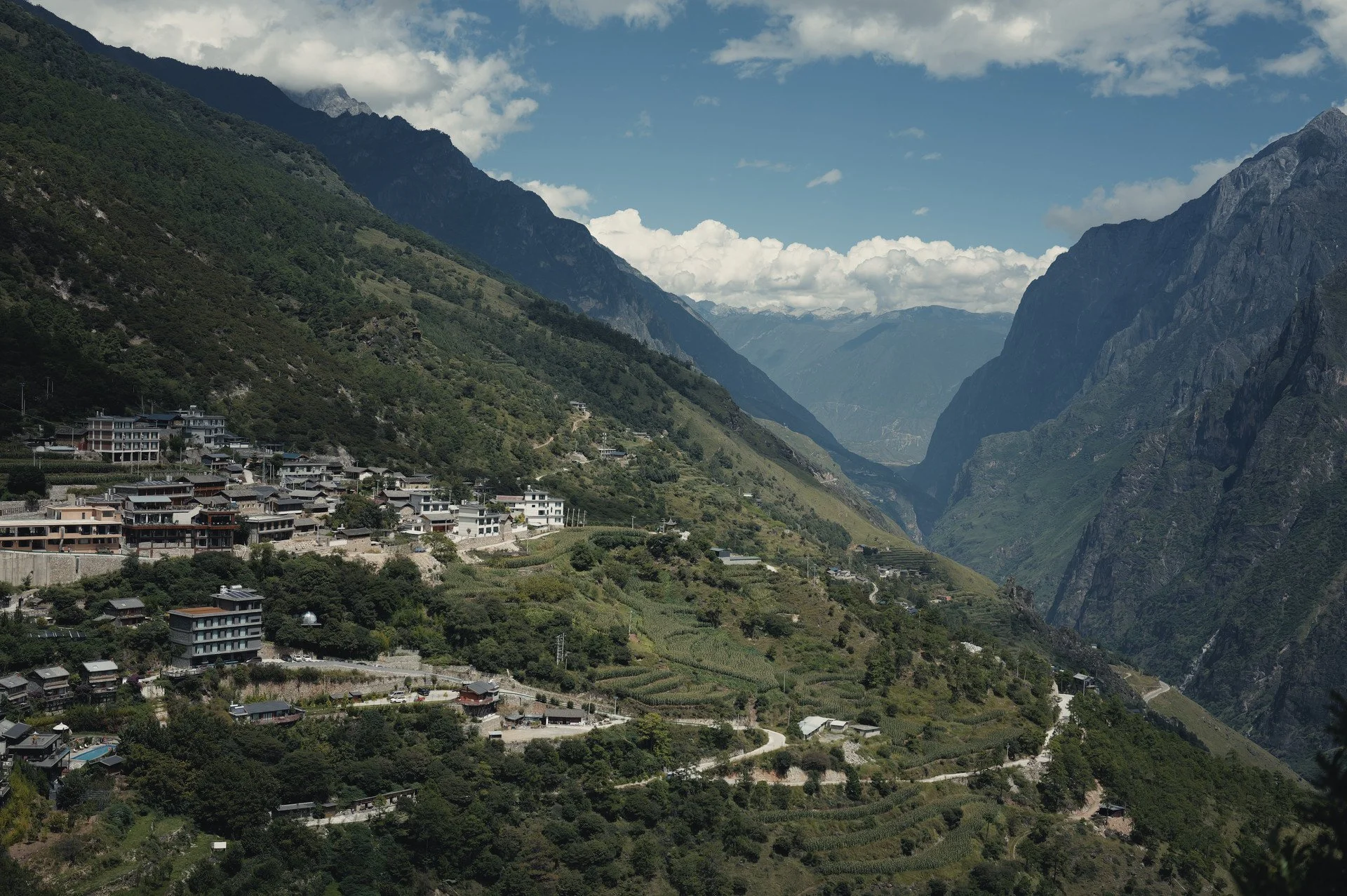
As of my recent trek on September 23rd, 2026, here is the up-to-date breakdown on logistics, trail conditions, and transport for Tiger Leaping Gorge.
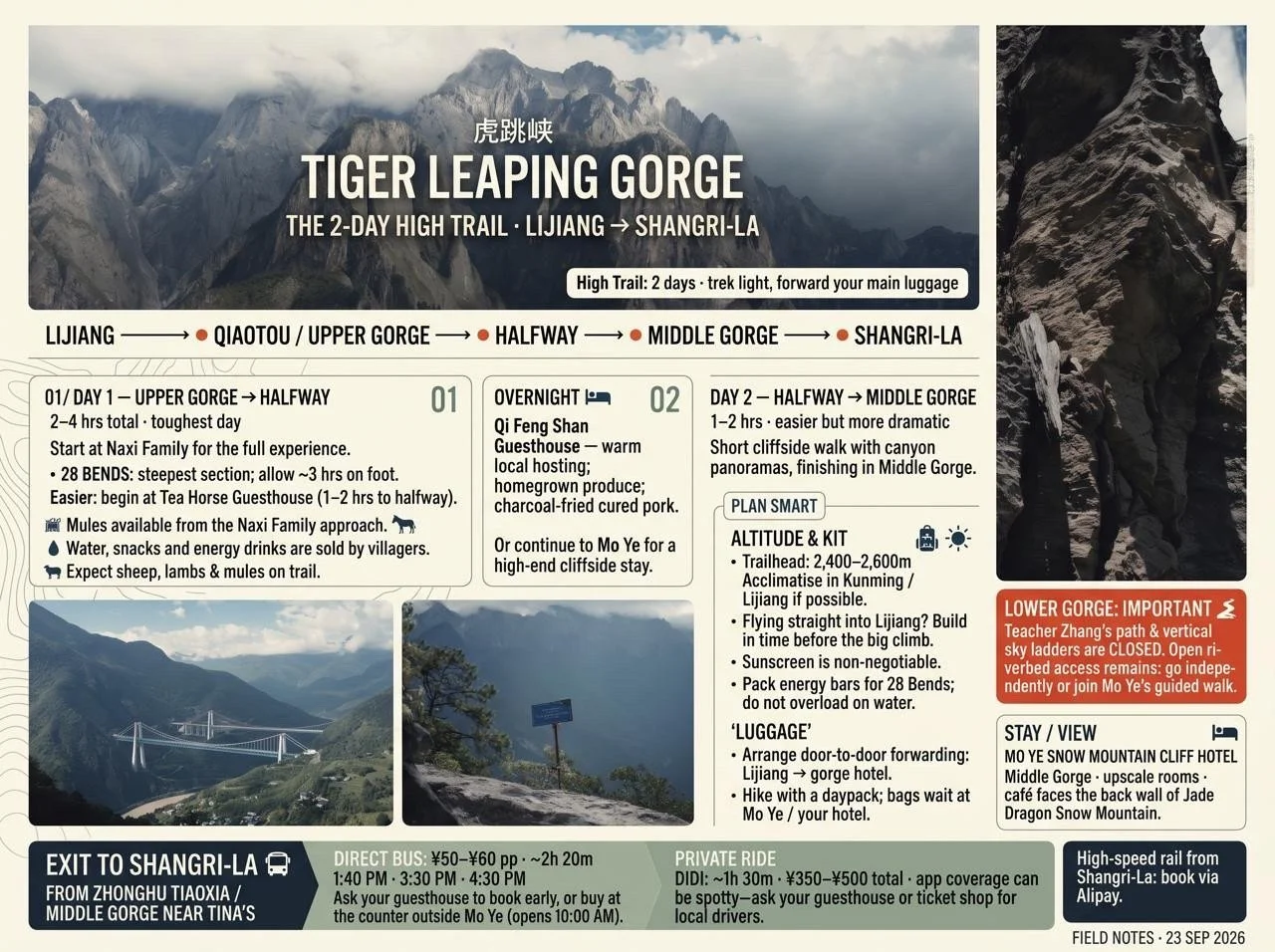
Tiger Leaping Gorge (虎跳峡) is one of the most breathtaking high-altitude treks in Yunnan—and it serves as the ultimate scenic bridge when traveling northbound from Lijiang to Shangri-La. Instead of taking a direct transfer between the two cities, hiking the High Trail over two days lets you experience the canyon up close before continuing on to Shangri-La.
To make sense of the area, it helps to know that the gorge is divided into three distinct sections:
Upper Gorge (上虎跳): Where the traditional trek begins near Qiaotou and Naxi Family Guesthouse.
Between Upper & Middle Gorge: The elevated cliffside stretch along the High Trail housing guesthouses like Halfway and Qi Feng Shan.
Middle Gorge (中虎跳): Further down the canyon where the High Trail finishes, housing guesthouses like Tina’s and Mo Ye.
Lower Gorge (下虎跳): Down at the very bottom where the roaring Jinsha River actually flows through the narrowest canyon walls.
1. Altitude Acclimatization & Trail Prep
How you approach altitude makes a massive difference, especially if you fly in from sea level. Because we gradually made our way up starting from Kunming (around 1,800m) to Lijiang (2,400m), before tackling the gorge trailhead (2,400–2,600m) and Jade Dragon Snow Mountain summit (4,500m+), our bodies had plenty of time to acclimatize naturally. Because of this progressive schedule, altitude sickness wasn't an issue for us at all on the gorge hike.
However, if you fly directly into Lijiang to start hiking right away, the sudden jump in altitude combined with intense climbing may trigger mild acute mountain sickness. If you tend to get altitude headaches, you might want to pick up a portable oxygen canister in Lijiang or consider talking to a doctor beforehand about Diamox tablets.
As for gear, sunscreen is absolutely non-negotiable—the UV radiation at 2,400 meters in Yunnan is intense even when the sun is hidden behind clouds. Don't worry too much about hauling excessive water weight from the very start. Local villagers set up small stalls along the trail where you can purchase bottled water, energy drinks, and snacks. While there is a slight markup due to the effort of transporting goods up the mountain, supporting the local trail economy and the villagers feels completely worth it. Just make sure to stash a couple of energy bars in your pack specifically to push through or recover right after the 28 Bends.
2. My Trail Experience & Day-by-Day Breakdown
The High Trail is structured as a two-day trek where Day 1 requires the heavy lifting, while Day 2 serves up thrilling cliffside views with significantly less physical effort.
Day 1: The Ascents, Animals & Reaching the Halfway Area
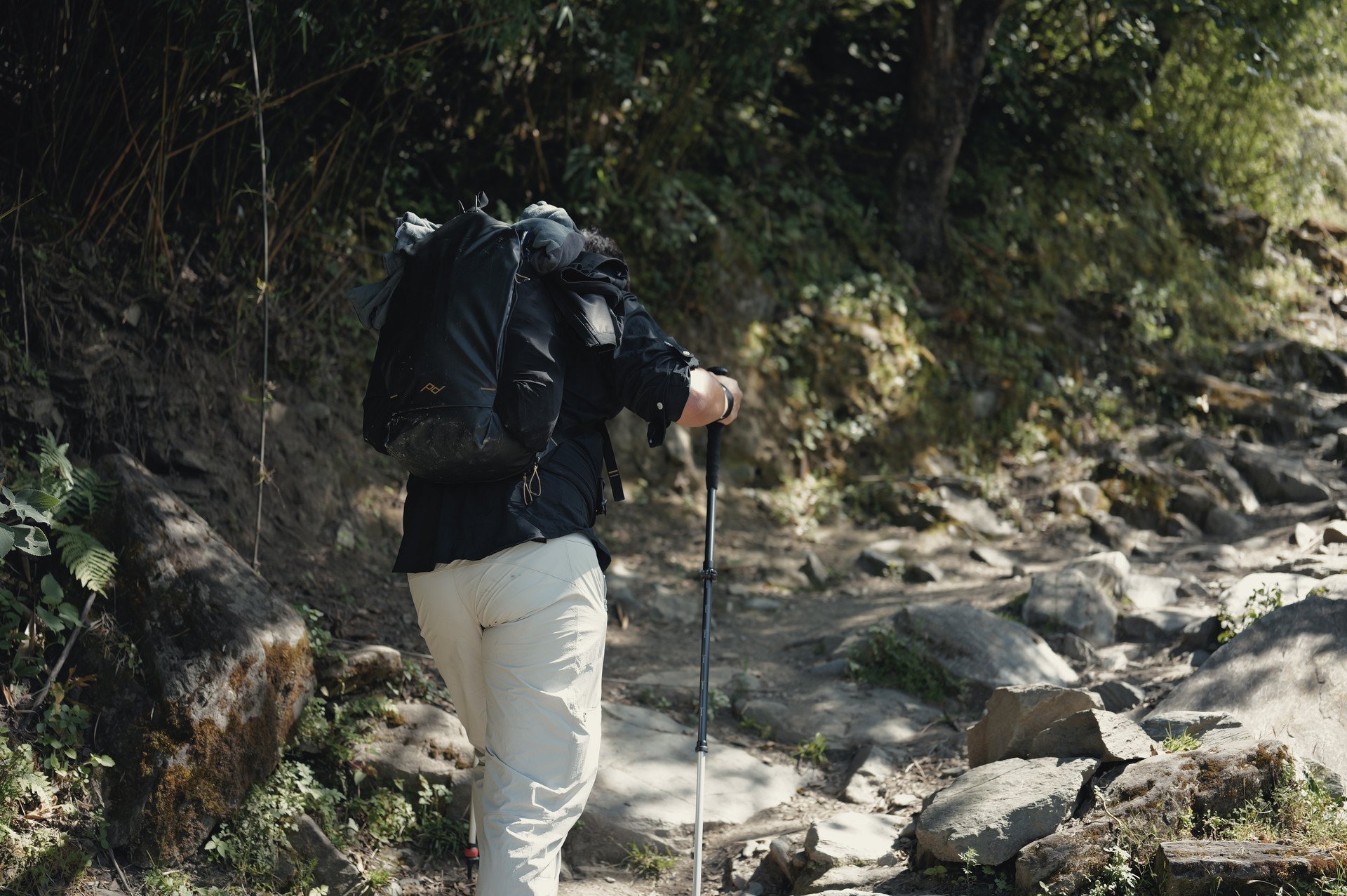
The first day is easily the toughest part of the trek because of the relentless climbing—most notably the notorious 28 Bends. If you decide to start your trek from Naxi Family Guesthouse in the Upper Gorge, you will have to tackle those steep 28 Bends on foot. As you hike along the road leading up from Naxi Family Guesthouse, local villagers will approach you offering rides on their mules up the incline. They can be quite persistent in trying to persuade you, but if you're feeling tired or simply want to support the local villagers and mountain economy, taking a mule ride is a great option.
Beyond the mules, the trail is filled with charming encounters with farm animals. Along the path, you'll see cute sheep, lambs, and mules roaming or resting alongside the trail, which adds a lovely rural atmosphere to the trek. If you prefer to skip the 28 Bends entirely, you can start your hike directly from Tea Horse Guesthouse instead.
Without the 28 Bends, Day 1 becomes surprisingly manageable, taking about 2 to 4 hours total depending on your pace (or just 1 to 2 hours if starting from Tea Horse to reach the halfway area). Taking on the 28 Bends on foot took us about 3 hours to complete. Once you reach the halfway mark between Upper and Middle Gorge, you can settle into your guesthouse to rest up and recharge for the evening.
Day 2: Cliffside Thrills to Middle Gorge (1 to 2 Hours)
Day 2 is a stark contrast to the first day—it is much shorter and easier, requiring only about 1 to 2 hours of walking. Despite being brief, it was easily my favorite and most thrilling stretch of the entire trek. You spend the morning walking along high, dramatic cliff edges with sweeping panoramic views of the canyon before making your final descent down into Middle Gorge.
3. Where to Stay: Homestyle Warmth vs. Upscale Luxury
Staying at Qi Feng Shan Guesthouse (奇峰山庄), located at the halfway stretch between Upper and Middle Gorge, was a fantastic surprise and ended up being much better than we expected. Everyone working there was incredibly warm, friendly, and welcoming, making the whole stay feel like being hosted in a local home rather than staying in a commercial hotel. The lady boss cooks exceptionally well, using fresh produce they harvest themselves. Their specialty house-cured fried pork cooked over charcoal was easily one of the best meals we had after a tiring day on the trail.
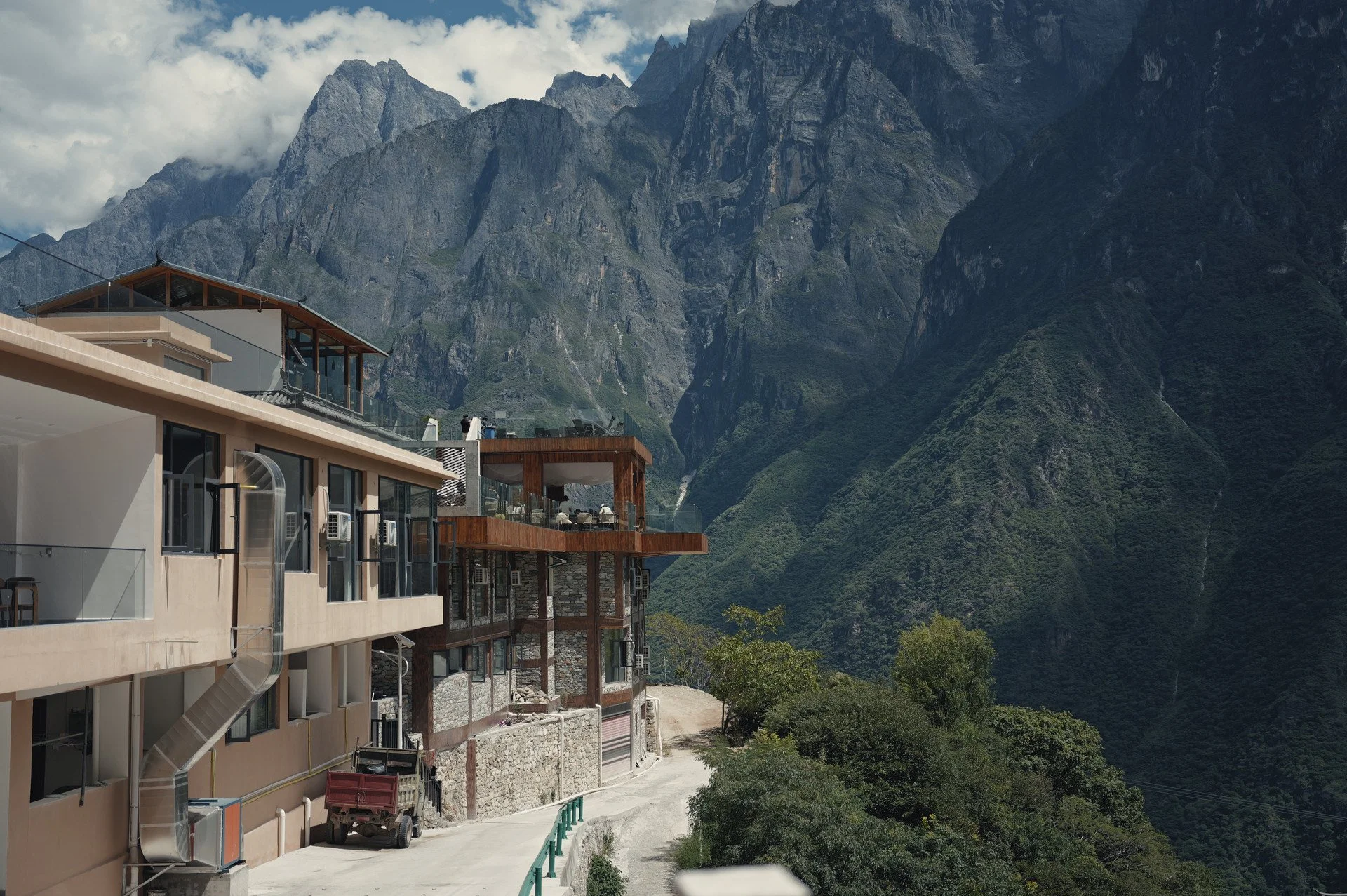
Located further along in Middle Gorge is Mo Ye Snow Mountain Cliff Hotel (默野雪山悬崖酒店), which is undoubtedly one of the most upscale and stylish properties in the area. Built with sleek, mountain-inspired architecture, it caters to travelers looking for high-end comforts. Many people visit Mo Ye specifically for the photos, as its on-site café directly faces the sheer back wall of Jade Dragon Snow Mountain, providing an incredible backdrop while you enjoy a coffee.
4. Optional Side Trip: Descending to Lower Gorge & the Riverbed
Before wrapping up your trip at Middle Gorge and catching your bus out, you can optionally hike down to Lower Tiger Leaping Gorge (下虎跳) to experience the roaring Jinsha River at water level.
Many older trail guides online reference taking the famous Zhang Laoshi (Teacher Zhang's) path down to the river and climbing back up the vertical steel sky ladders. Please note that as of September 2026, those older routes and sky ladders remain completely closed due to safety incidents and rockfall concerns, so plan accordingly to avoid disappointment.
Fortunately, there is still an open and accessible path down to the riverbed. If you stay at Mo Ye, you can join their hotel-guided hike down to the river rapids in the Lower Gorge, or you can choose to tackle the path independently. Standing right at the bottom with the muddy, thundering river roaring between the narrow canyon walls gives you an incredible, visceral perspective that you just can't get from high up on the cliffside trail.
5. Luggage Strategy & Transport Out to Shangri-La
Since you are traveling onward from Lijiang to Shangri-La, do not trek with your heavy suitcases. Arrange a door-to-door luggage transfer before starting. Have your driver or transport service send your main bags directly from Lijiang to your destination hotel in the gorge—such as Mo Ye in Middle Gorge—so your luggage is waiting in your room when you arrive.
After wrapping up your hike and optional river descent, head to Zhonghu Tiaoxia (Middle Gorge) near Tina's Guesthouse to catch your transport up to Shangri-La.
Direct Bus 【中峡景区直通车】: Around 2 hours 20 minutes, ¥50–¥60 per person. Daily departures are 1:40 PM, 3:30 PM, and 4:30 PM. Book early.
Ride-Hailing (Didi) or Private Ride: Around 1 hour 30 minutes, ¥350–¥500 total. Faster and flexible, especially for groups of three or four splitting costs.
Booking Your Bus Ticket: Ask your guesthouse to help book in advance, or purchase tickets at the counter outside Mo Ye Hotel, which opens at 10:00 AM.
Backup for Ride-Hailing: Didi coverage inside the gorge can be spotty. If app drivers aren't appearing, your guesthouse or the Middle Gorge ticket shop can connect you with local private drivers.
Onward Rail Connections: High-speed train tickets out of Shangri-La station can be booked via 12306 on Alipay.
TL;DR Quick Summary
1. Route: Travel northbound from Lijiang to Shangri-La via Tiger Leaping Gorge over two days.
2. Luggage: Forward heavy suitcases from Lijiang directly to your gorge hotel and hike with a daypack.
3. Day 1 (2–4 hours): Skip the 28 Bends by starting at Tea Horse Guesthouse, or hire a mule from Naxi Family Guesthouse.
4. Stay: Choose Qi Feng Shan Guesthouse for warmth and home cooking, or Mo Ye Snow Mountain Cliff Hotel for upscale rooms and mountain views.
5. Day 2 (1–2 hours): An easy, short, thrilling cliffside walk into Middle Gorge.
6. Riverbed: Legacy routes and sky ladders remain closed, but open riverbed paths exist in Lower Gorge.
7. Transport: Reserve the direct bus to Shangri-La (¥50–¥60, about 2h 20m) through your guesthouse or the counter outside Mo Ye.